League of Legends Champion Ability Design
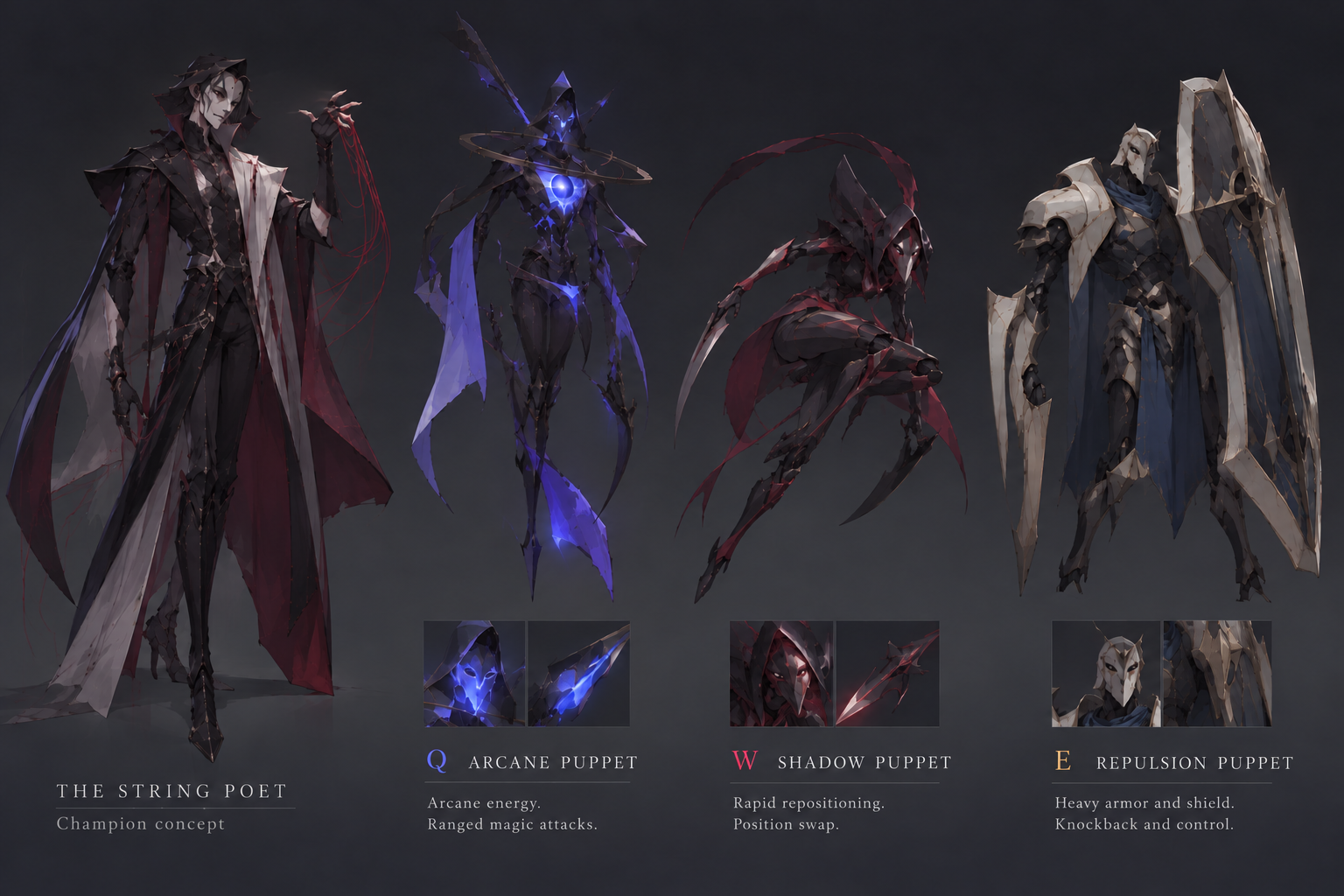
The String Poet — an original mage / controller who turns three puppets, their positions and their returning threads into a combat system.
Ability showcase
Prototype v1 · 55 seconds
The String Poet in motion
A Unity gameplay recording with English on-screen captions. Watch the complete kit, or jump to a mechanic below.
1920 × 1080 · 60 fps · In-engine capture · Open video ↗
Design evolution
Click a node to explore
From puppetmaster fantasy to playable decisions
Follow the reasons behind each iteration: reduce execution overhead, preserve positional expression and make every returning thread matter.
The puppetmaster fantasy
Pain from Naruto inspired the idea of one will expressed through several bodies. My love of Jhin’s unsettling murderer-as-artist identity suggested the personality: an Ionia-inspired poet who treats his puppets as verses and combat as a performance.
01 · Inspiration & character concept
Visual direction
One will. Three bodies. A twisted performance.
Pain from Naruto sparked my interest in a character whose will acts through several bodies. Jhin’s identity as a disturbed artist who turns murder into performance is another character direction I love. Together, they shaped The String Poet: an Ionia-inspired, unsettling artist who calls himself a poet and treats his puppets as his verses.
The design challenge was to carry that fantasy into readable combat: commanding several bodies should feel expressive without requiring constant independent unit control.
Design decisions
Problem → iteration
Reduce the inputs. Keep the decisions.
The initial concepts were reworked into the current two-cast prototype. These are my design judgments and intended player behaviours; the showcase demonstrates mechanics against test dummies.
Several bodies compete for attention
The initial fantasy was a controller independently directing multiple puppets’ movement and attacks. I felt the input burden would overshadow combat decisions.
Give each puppet a clear function
Azir’s approach to placing and moving soldiers inspired a simpler structure. Q threatens damage, W provides a position swap and E creates displacement. Each puppet has a distinct job.
Three actions delay a response
Summon → move → activate asks for too much preparation when a threat suddenly reaches the champion. A Rengar leap was my concrete stress case for this proposal.
Combine creation and placement
Deploy → activate reduces the sequence to two casts. E already pushes enemies aside during deployment; its recast pushes one enemy away. The kit retains setup decisions with less execution overhead.
The fight ends at the recast
An early basic-attack mark passive did little to reinforce the puppet-and-thread identity. I wanted movement to remain useful throughout the exchange.
Turn recall geometry into pressure
After a second cast, the puppet returns and damages enemies in its path. Repositioning changes that path, creating intended opportunities to kite, punish pursuit and turn a retreat into a counterattack.
A fixed ultimate ignores preparation
If R always delivers the same payoff, the number of puppets committed to the field has little consequence.
Scale the payoff with commitment
R’s damage and radius scale by one third per puppet. Only three puppets unlock the central knock-up. The design asks whether to use a partial ultimate now or preserve the field for a stronger convergence.
Current kit
Mage / Controller · Prototype values
Deploy → activate → recall
Three functional puppets share one loop. The second cast resolves the puppet’s ability, then its return adds a further positioning challenge. Values below describe the current prototype and remain open to balance testing.
Threadbound
After a recast, the puppet returns along its thread and damages enemies in its path. Puppets beyond the 1,000-unit thread limit are also recalled.
Positioning defines the return path. The distance limit constrains how far the player can maintain a formation.
Arcane Puppet
Deploy up to 500 units, then recast for a cone of arcane force from the puppet’s position. Deployment itself deals no damage.
Separate placement from damage so the player has to choose the attack origin and the moment to fire.
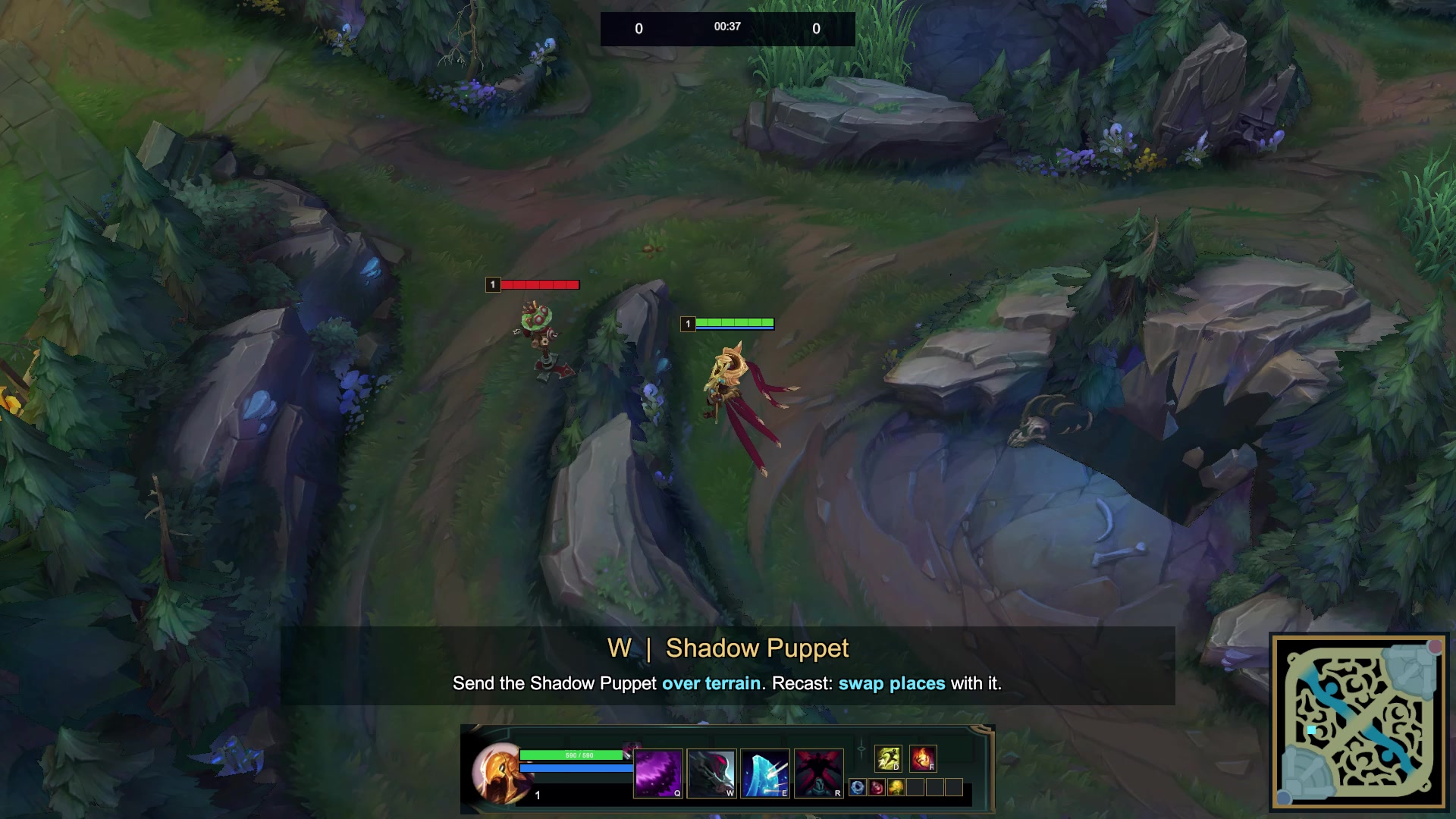
Shadow Puppet
Deploy up to 400 units across terrain, then recast to swap positions with the puppet. Deployment itself deals no damage.
Create a relocation option for escape, pursuit or a changed recall angle. Its range increased from the initial 300 units.
Repulsion Puppet
Deploy up to 500 units, damaging enemies and pushing them 120 units to either side. Recast for a 250-unit shield charge that drives one enemy forward, with wall-impact feedback.
Offer immediate space-making during deployment and a more directed answer on the recast. Reduced lateral push avoids excessive displacement.
Triune Collapse
Puppets within 1,000 units converge and detonate. Each contributes one third of the full damage and radius. At three puppets, the inner zone knocks enemies airborne.
Reward full setup while allowing a smaller immediate response. Outer damage and inner control indicators communicate the different zones.
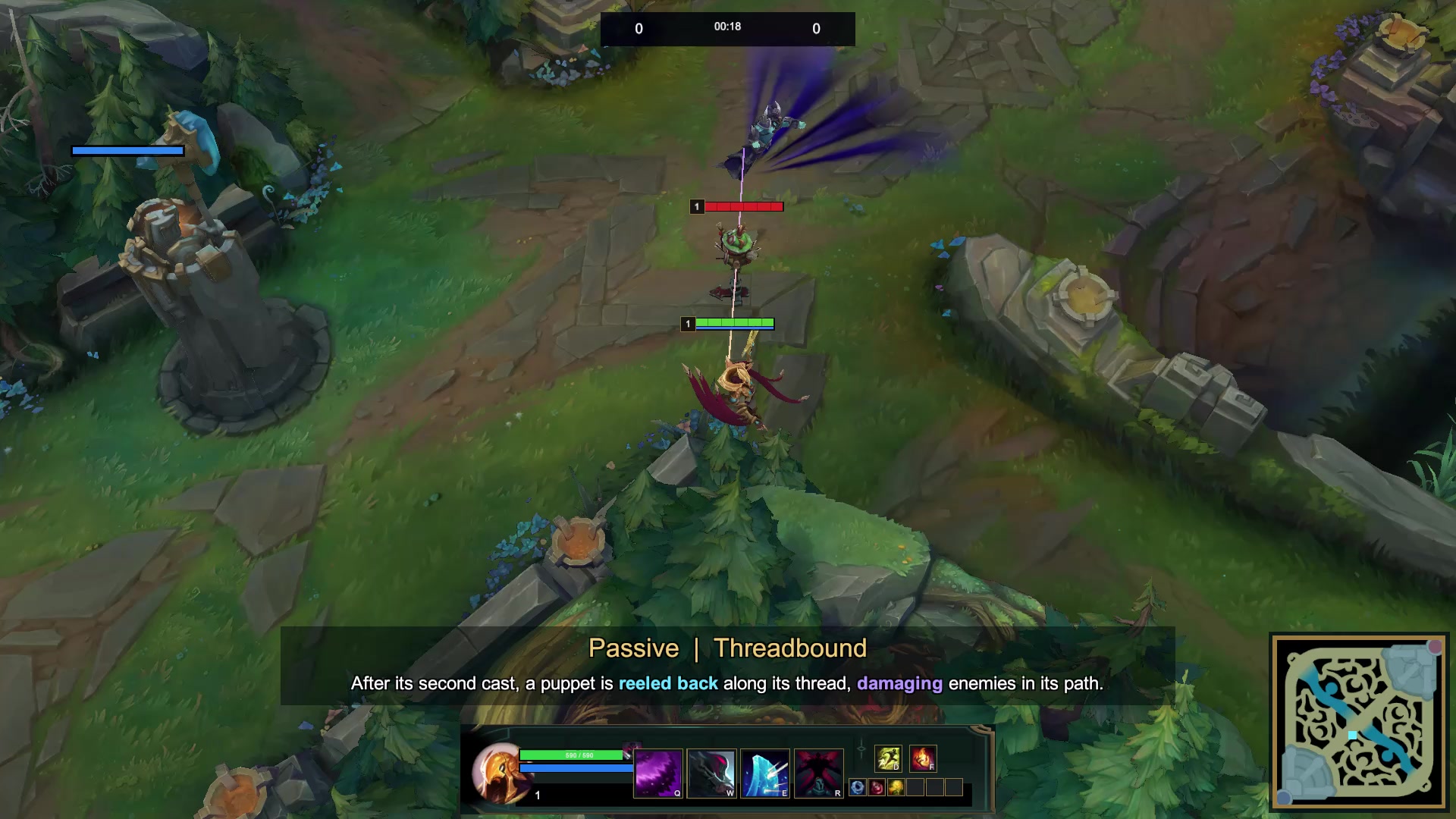
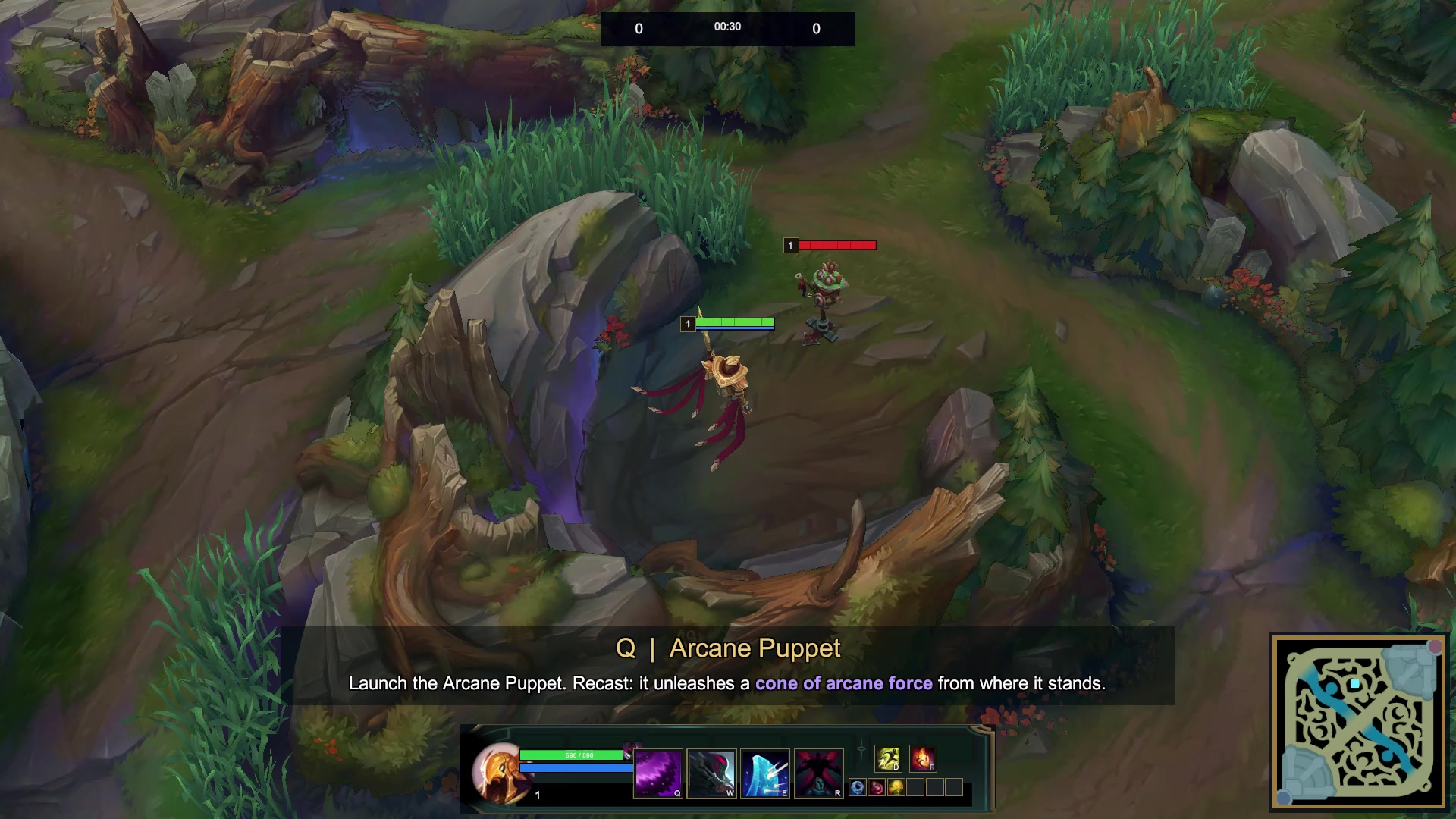
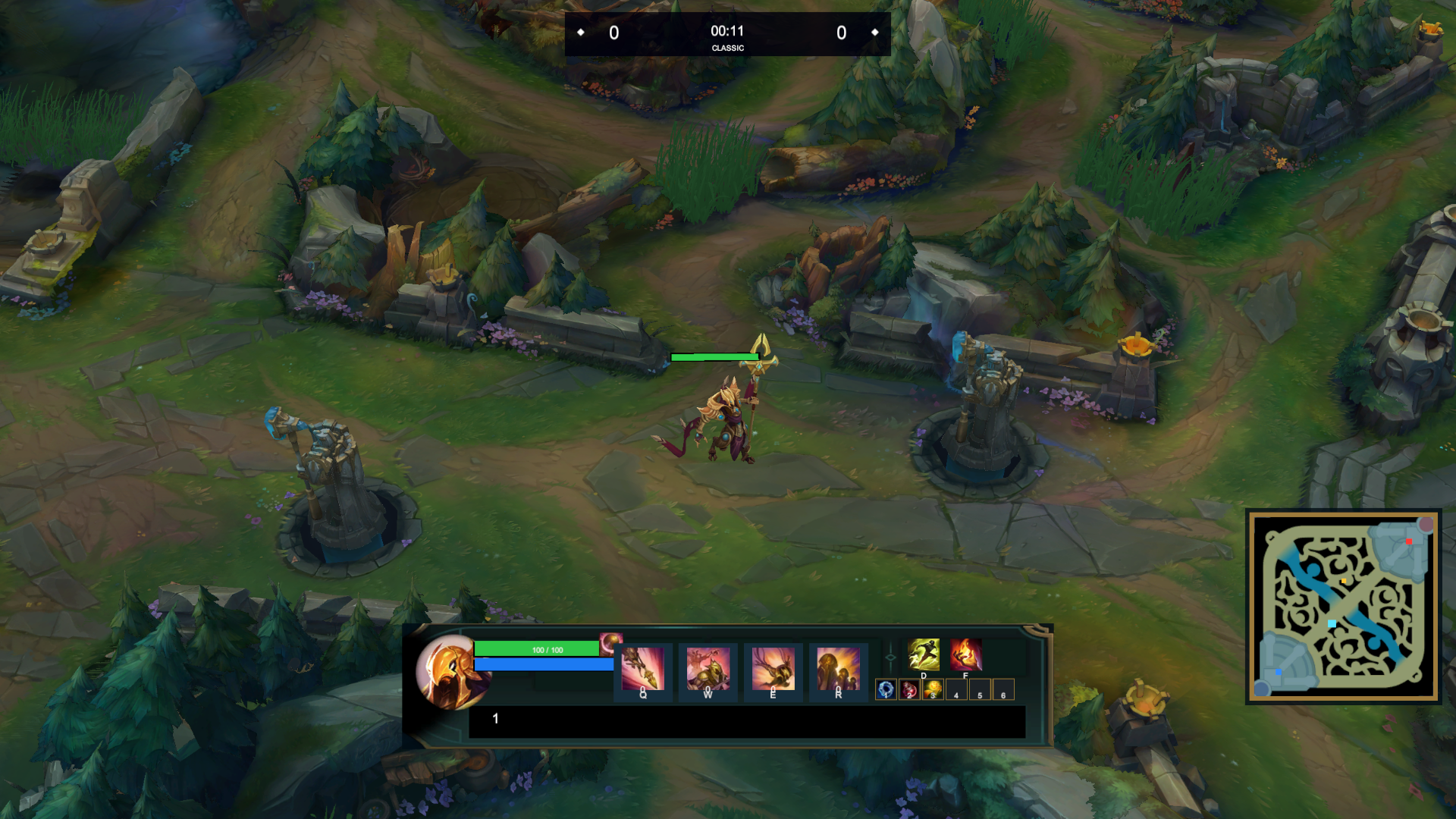
Environment validation · Character scale, terrain, vegetation, camera and HUD.
Judge the kit in a familiar combat space
I wanted the prototype to answer how this champion might feel inside League. In Unity 6 with URP, I assembled a Rift-style sandbox with game-unit scale, an isometric camera, right-click movement, QWER controls, terrain collision, practice dummies and a League-style HUD.
A shared coordinate conversion uses 1 Unity unit for 100 game units. NavGrid-based ground and wall checks support movement, wall sliding, corrected Flash destinations and W’s cross-terrain placement. Camera framing and scale were calibrated toward League’s presentation; the result is a champion test environment rather than a complete match simulation.
Prototype workflow
Design → playable evidence
Build tools that keep iteration repeatable
With AI coding assistance, I turned repeated conversion, setup and recording tasks into tools so I could spend more time making design decisions and evaluating the result in-engine.
Implement the loop
A puppet state machine handles flight, placement, activation, convergence and recall. Exposed Inspector values make range, timing and displacement easy to tune.
Make effects readable
Python conversion and a Unity editor importer turn effect definitions into particle prefabs. Shader fixes address UV clamping, particle-age scrolling, vertex alpha and Gamma-style additive blending.
Play, diagnose, verify
I replayed the prototype, described the observed issue and checked the next revision visually. E’s push direction follows the charge; shield disappearance and hit-stop were adjusted for clearer impact.
Stage the showcase
An F10 demo director finds suitable terrain, stages seven mechanic examples and records through Unity Recorder. Wall-detour checks make W’s demonstration meaningful; staging avoids brush because vision is not implemented.
Prototype evidence
Frames from the uploaded showcase

My role & scope
What this prototype demonstrates
Design ownership, with AI-assisted development
My contribution
I owned the champion concept, kit mechanics, iteration decisions, numerical and game-feel judgment, playtest feedback and showcase narrative. Claude Code and Codex assisted with substantial code implementation, tools and asset conversion.
Placeholder art
I have no formal art background, so Azir represents the champion; Kassadin, Zed’s shadow and Braum stand in for the three puppets. Their silhouettes and effects communicate the functions. Original character work is in progress; the footage shows a mechanics prototype.
Next validation
Add opponent heroes and minion pressure to test reaction windows, counterplay and teamfight readability. Implement brush vision, then assess terrain interactions. Balance and competitive viability are still unvalidated.
From watching every reveal to making my own
I never miss a League of Legends champion preview. I wanted to make one myself: take an idea, question its execution burden, build the revised kit and present it through an ability showcase. This project is a step toward my ambition to become a game designer at Riot Games.
“All are puppets. Only I hold the strings.”
Fan-made, non-commercial champion concept. League of Legends and all related reference assets belong to Riot Games. This project is not endorsed by Riot Games. This page presents gameplay video and screenshots.
Next projectCars Don’t Fly→